Last tutorial we looked at adding headers, lyrics and chords to our version of ‘Mary had a Little Lamb’, so go and have a read if your unsure about those things! This time we’ll be looking at notating some more complex tunes.
An alternate tune
While most people sing ‘Mary had a little lamb’ to the tune of ‘Merrily we roll along’, there is another tune, composed by Lowell Mason a few decades after the rhyme was penned. This tune, notated below, has a more complex melody and harmony, and preserves the original form of the rhyme much better, resulting in more complex word-setting too.
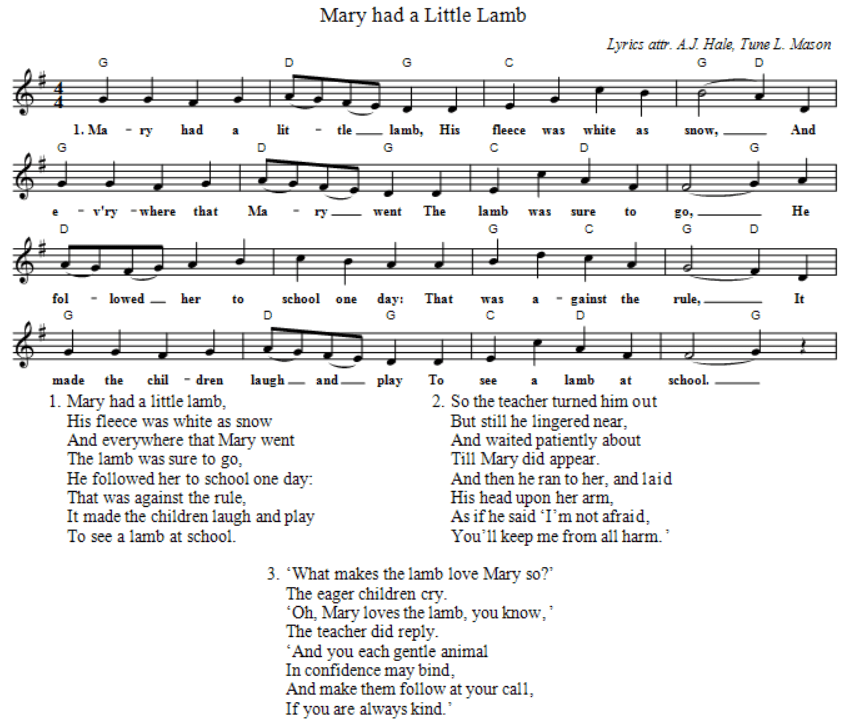
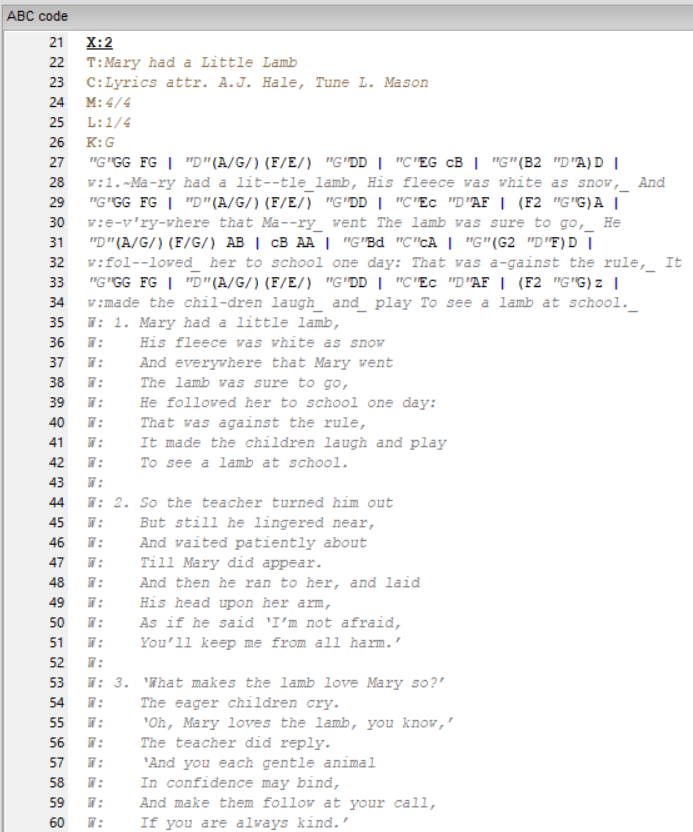
Firstly, we see the notation of quavers using “/” (forward slash) as a shorthand for “/2”, making it quicker and easier to write out notes that are half the unit value. On top of this the shorthand for “/4” to write a note a quarter of the unit value is simply “//”.
Slurs and underlay
We also see the use of slurs. Though these don’t often come up in instrumental folk music, it is modern typesetting convention to put slurs over vocal music when there is more than one note per syllable. In this way they show clearly where to change syllable in a passage with many notes but few syllables. In ABC notation, slurs are indicated using parentheses “()”, with the left parenthesis going before the start note of the slur, and the end parenthesis going after the end note.
With these slurs, we also see dashes “-” and underlines “_” in the underlay to indicate the lengthening of a syllable. These just make it clear which notes go with which syllables by spacing the syllable out under the notes. Dashes are used in the middle of a word, much like you might hyphenate a compound word, and underlines are used after the final syllable.
An Instrumental Tune
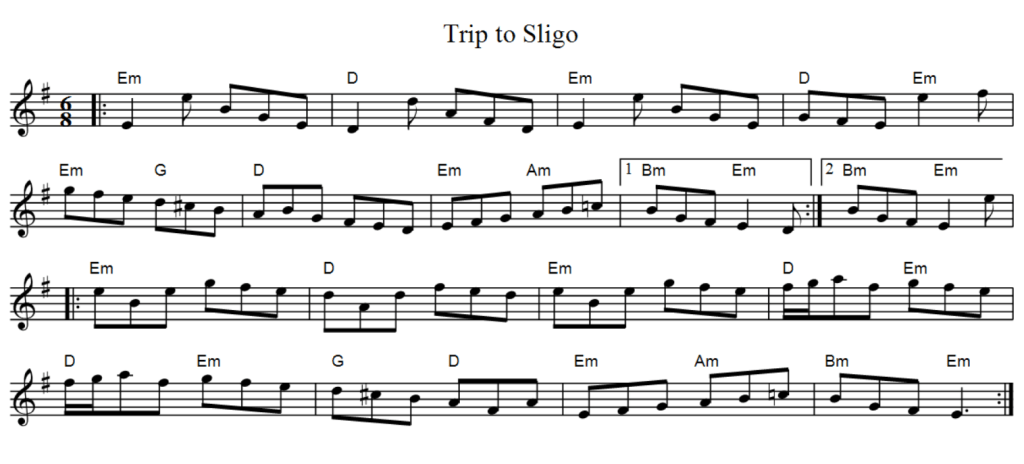
So far we’ve dealt only with song, but this isn’t really ABC notations primary use case: it’s mostly used for instrumental tunes. As an example, below is the tune “Trip to Sligo”, an Irish tune that uses some of the final important functionalities of ABC notation, rounding out this tutorial series.
Dance type
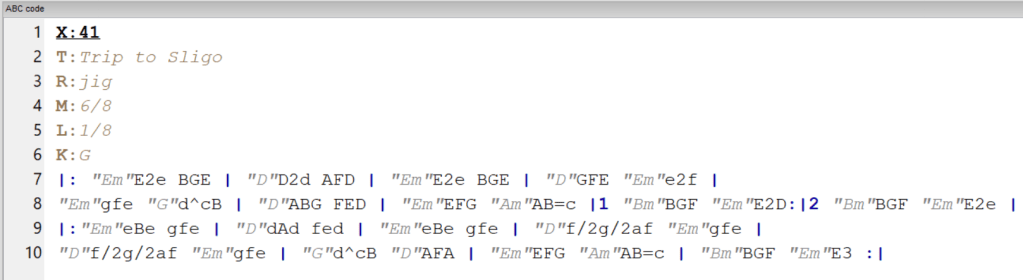
Folk music is a music for dancing, and so most folk tunes, and almost all traditional tunes, can be split quite clearly by dance type and length. What those different dance types are, and how tunes should be split among them is a debate that I won’t get into here, but suffice to say that “Trip to Sligo” is uncontroversially a jig. If you want to learn more, irishtunes.info has a very thorough page on the distinctions generally agreed upon in Irish traditional music, and there are countless threads on the Session discussing the differences between types of tune.
Once you have decided/debated the dance type, it is notated in the “R:” field (short for rhythm). The “R:” field doesn’t do much for a tune in most cases, since it isn’t displayed in the compiled staff notation. A notable exception to this is “R: hornpipe”, which changes the EasyABC MIDI playback so that quavers are swung, since this is how hornpipes are generally played.
Repeats
This tune is of the very common AABB structure, indicated here by repeats, and first and second time bars. Repeats are indicated by a colon to one side of a barline, forming an plain-text representation of a repeat sign “:|”.
First and second time bars are indicated by simply placing a number directly after the barline in question. So as we can see “|1” indicates a first time bar, “|2” a second time bar and so on. These repeat bars are closed by either a repeat sign, or a double bar (indicated by “||” or “|]” depending on the finality)
Accidentals
The tune here uses a few accidentals. These are not as straightforward as you might assume in ABC notation, since “b” is taken up by a letter name already, so can’t be used as an accidentals. Instead of the usual “#” and “b”, ABC notation opts for “^”, “=” and “_” to indicated, sharpening, naturalising and flattening respectively. These symbols appear before the affected note, produce symbols in the final staff notation.
Exporting

Now that you’ve got some abc files, and a good handle on how to write more, you might want to export the staff notation as a PDF. EasyABC has this functionality, but doesn’t actually include the scripts to do the conversion, which the user has to install themselves. Luckily the script in question is GhostScript (at least for Windows and Linux) which is freely available and easy to install. You just have to install it, and then go to Settings -> ABC settings -> File Settings and input the location of ghostscript’s exe file (somewhere in program files -> gs -> bin). Happy book making!
Thanks for reading! This is the end of the core functionalities of ABC notation, so tutorials will drop off now, though I may update this series with more niche tutorials in the future. I do have one more tutorial already planned though, so next time we’ll be looking at writing multi-part music, and how to set up scores!
 lankfish
Leave a comment